Tag Archives: italy

World Cup 2014: Who will get beyond the group stages?

Following last week’s draw for the 2014 World Cup in Brazil, Will Cafferky looks at each of the eight groups that were announced and offers his predictions as to which teams will progress.

Will Bayern Munich's Mario Mandzukic make an impression on the world stage? Photo: sloanecroatia.com
Will Bayern Munich’s Mario Mandzukic make an impression on the world stage? Photo: sloanecroatia.com

Group A 

It’s hard to see anyone other than the hosts triumphing in this one, with Croatia probably presenting the toughest challenge. Mexico will be hoping their current transition phase is before the tournament starts, whilst Cameroon need to ensure that they correct the divisions starting to form within the squad if either hope to challenge for the second spot up for grabs.

Prediction: Brazil and Croatia to progress

Key Players: Neymar, Thiago Silva, Kaka, David Luiz, Oscar (Brazil), Mario Mandzukic, Luka Modric (Croatia), Javier Hernandez (Mexico), Samuel Eto’o, Alexander Song (Cameroon)

Group B

This proves much less straight forward than Group A; without wishing to use the label “group of death”, there’s no doubting this is a strong group. 2010’s finalists Spain and the Netherlands speak for themselves. However, as I recently discussed for Exeposé, Chile go into the tournament looking very strong and could upset the Dutch. Meanwhile, spare a thought for Australia.

Prediction: Spain and Chile to progress

Key Players: Jordi Alba, Xavi, Iniesta, David Silva, Cesc Fabregas (Spain), Gary Medel, Arturo Vidal, Alexis Sanchez (Chile), Wesley Snjeider, Robin Van Persie (Netherlands), Miles Jedinak, Tim Cahill (Australia)

Group C

One of the weaker groups of the cup, Group C is without any of the main big hitters. Columbia undoubtedly boast the strongest squad and will look to capitalise on a favourable draw. Ivory Coast will be thankful to finally get a bit of luck with a World Cup group, and this arguably presents their best opportunity to progress to the next round with Japan and Greece likely to prove little more than cannon fodder.

Prediction: Colombia and Ivory Coast to progress

Key Players: Rademel Falcao, Jackson Martinez, James Rodriguez, Fredy Guarin (Colombia) Yaya Toure, Kolo Toure, Wilfried Bony, Didier Drogba (Ivory Coast), Kesuke Honda, Shinji Kagawa (Japan), Sokratis, Kostas Mitroglou (Greece)

Could Southampton star Adam Lallana ruffle a few feathers against Italy and Uruguay? Photo: telegraph.co.uk

Group D

There were few draws that could have been harsher to England – whilst they did avoid Spain and Germany, they did manage to get the next best thing. Italy are a team in the ascendency under manager Cesare Prandelli, whilst few teams in world football can claim to have two better strikers than Uruguay. It’s hard to see England escaping alive, with the only respite coming in the quivering shape of Costa Rica.

Prediction: Italy and Uruguay to progress

Key Players: Gianluigi Buffon, Giorgio Chiellini, Andrea Pirlo, Mario Balotelli (Italy) Luis Suarez, Edinson Cavani, Diego Forlan (Uruguay), Steven Gerrard, Jack Wilshere, Wayne Rooney, Joe Hart (England), Bryan Ruiz (Costa Rica)

Group E

The unseeded France will be rather happy with the result of the draw, as they look favourites to redeem their disastrous 2010 campaign. Honduras will likely prove to be the proverbial doormat, whilst Ecuador and Switzerland will battle for second place, with the latter coming out on top.

Prediction: France and Switzerland to progress

Key Players: Hugo Lloris, Mamadou Sakho, Frank Ribery, Paul Pogba, Samir Nasri (France), Stephan Liechtensteiner, Valon Behrami, Xerdan Shaqiri (Switzerland), Antonio Valencia, Felipe Caicedo (Ecuador), Wilson Palacios (Honduras)

It's time Leo Messi made an international tournament his own. Photo: empireofsoccer.com
It’s time Leo Messi made an international tournament his own. Photo: empireofsoccer.com

Group F

This group seems fairly straightforward; Argentina’s overwhelming attacking talent will probably send shivers down the spines of Iranian defenders. Meanwhile, Bosnia-Herzegovina will likely be satisfied with the draw, especially following Nigeria’s fairly woeful display at the Confederations Cup earlier this year.

Prediction: Argentina and Bosnia-Herzegovina to progress

Key Players: Javier Mascherano, Pablo Zabaleta, Lionel Messi, Sergio Aguero, Carlos Tevez, Gonzalo Higuain, Ezequiel Lavezzi (Argentina), Asmir Begovic, Miralem Pjanic, Zvjezdan Misimovic, Edin Dzeko (Bosnia-Herzegovina), John Obi-Mikel, Victor Moses, Obafemi Martins (Nigeria), Reza Ghoochannejhad (Iran)

Group G

Germany are the favourites of many a pundit for Brazil 2014. Whilst Portugal, Ghana and USA present tough opposition, it’s hard to imagine anything other than an efficient group stage from the Germans. Portugal endured a hairy play-off tie with Sweden to earn their place, and whilst USA and Ghana enjoyed more relaxed campaigns, it’s hard to picture either coping with the superhuman ability of Cristiano Ronaldo.

Prediction: Germany and Portugal to progress

Key Players: Manuel Neuer, Philipp Lahm, Mats Hummels, Bastian Schweinsteiger, Thomas Muller, Mesut Ozil, Mario Gotze (Germany), Pepe, Joao Moutinho, Cristiano Ronaldo, Nani (Portugal), Sulli Muntari, Kwandwo Assamoah, Asamoah Gyan, Kevin-Prince Boateng (Ghana), Tim Howard, Jozy Altidore, Michael Bradley, Clint Dempsey, Landon Donovan (United States)

Group H

Belgium couldn’t have wished for a better group as they look to capitalise upon their impressive qualifying campaign. Labelled a “golden generation,” the team is littered with Premier League superstars. Meanwhile, Fabio Capello’s Russia will face stiff competition from a promising Algeria side for the second spot in the round of 16, with South Korea also destined for an early exit.

Prediction: Belgium and Russia to progress

Key Players: Jan Vertonghen, Vincent Kompany, Alex Witsel, Moussa Dembele, Marouane Fellaini, Eden Hazard, Christian Benteke, Romelu Lukaku (Belgium), Igor Akinfeev, Aleksandr Kerzhakov, Yuri Zhirkov, Alan Dzagoev (Russia), Ryad Boudebouz, Sofiane Ferghouli (Algeria), Ki Sueng-Yueng, Kim Bo-Kyung, Lee Chung-Yong, Ji Dong-Wong, Park Chu-Young (South Korea)

Like Exeposé Sport on Facebook and follow us on Twitter for all the latest in university, local and global sport.

What is… The European Union?

Better off in, better off out… the debate is endless, but public knowledge about this international organisation is not. Just what is the European Union?

European Flag Image credits: R/DV/RS
the European Union Flag
Image credits: R/DV/RS

What we call today the European Union has existed in various forms since its creation. Currently, this political and economic partnership exists between twenty-eight countries which are, unsurprisingly, situated in Europe.

History

It all began after the Second World War, the idea being that countries which trade would be less likely to go to war with each other. By 1958, the European Economic Community (EEC) was established out of the 1951 European Coal and Steel Community between six initial countries – Belgium, Germany, Luxembourg, France, Italy and the Netherlands –freeing up the borders between them to allow better trade links.

We, the United Kingdom (in case you were not so sure), have always been a bunch of sceptics, refusing to make the “Inner Six” a “Seven” in the beginning, and then later joining in 1973 (with a bit of persuasion from the USA and the Suez Crisis). Shockingly, or perhaps not at all, our [poor] relationship with the French meant it would take three attempts at membership and Charles de Gaulle’s departure from the French presidency for them, fearing too much US involvement, to finally stop saying non and ruining our chances.

Now

The EEC became the European Union (EU) in November 1993 under the Maastricht Treaty, establishing what are known as its “Three Pillars”: the European Community – removing the word “Economic” to show the wider policy range it now covers; Common Foreign and Security Policy; and Police and Judicial Co-Operation in Criminal Matters.  Although the latter two Pillars are largely based on international co-operation between member states with representatives working together on relevant issues, the first Pillar contains the supra-national institutions – those who have authority over individual national governments – and all of their work.

To begin, the European Commission is responsible for proposing legislation, upholding the Treaties they establish and running the EU from day to day. Each member state sends a single representative, making a total of twenty-eight members. The President of the European Commission is elected from these twenty-eight by the European Parliament. Don’t confuse this with the President of the European Union (who is actually the head of the European Council), currently President van Rompuy of Belgium!

The European Council has no strict power to make laws, but it is a body of the heads of government of each member state and is responsible for “the general political directions and priorities” of the EU according to the Lisbon Treaty. It acts as a body to be the presidency of the Union, and the head of the Council is its representative.

European Parliament, Strasbourg Image credits: Salim Shadid
European Parliament, Strasbourg
Image credits: Salim Shadid

The next institution is the European Parliament. If you have ever voted for a Member of the European Parliament as we are charged to do every five years (the next time being in 2014), this is where the 766 of them elected across the Union work. Depending on their political opinions, they join forces with politicians of similar views to create larger voting blocs such as the Greens or the Progressive Alliance of Socialists and Democrats. Its job is to debate and vote on legislation, although it can’t actually use its initiative to create it itself. It does, however, have the second largest electorate (or voting population) in the world after India, and the largest trans-national democratic electorate, with 376 million eligible voters at the last elections.

Despite its lack of initiative, it does share power over the budget with the Council, and has to hold the European Commission shares equal legislative and budgetary powers with the Council and, just to confuse you, has its own President – currently Martin Schulz.

Finally, there is the European High Court of Justice which is the highest court of the EU and based in Luxembourg. It is mainly responsible for making sure all EU law is applied fairly across the Union. Again, each member state sends one judge and so there are twenty-eight of them, although it’s uncommon for all of them to hear every single case.

The Euro

Coming fully into force in 2002, the euro is the currency of seventeen of the twenty-eight member states, also known as the eurozone. A better currency for trading purposes, as well as a sense of unity, the eurozone is estimated by the International Monetary Fund as the second largest economy in the world, and the euro is the most-traded currency after, of course, the US dollar. If you’re as strange as I am (and commiserations if you are), you may have noticed from your travels to the eurozone – perhaps Spain, France, Finland or Ireland – that each country has a different design on the back of coins initially introduced into that country. “RF” for “République Francaise” or the French Republic is stamped across the French euro coins, for example.

The euro has been the cause of much debate and controversy in the UK. You won’t need me to point out to you that we are still in possession of the Great British Pound Sterling for currency, but there has been past discussion amongst British politicians about abandoning it for the euro. Whilst the Maastricht Treaty establishing the EU compelled most member states to swap their pesetas, francs and deutschmarks (among many others) for the euro, Denmark and Britain both notably negotiated exceptions.

New Labour, elected to power in 1997, was cautiously optimistic about joining, dependent upon our passing five particular economic tests first although it was a relatively minor issue in the end, despite William Hague’s decision to run his 2001 election campaign based, bizarrely, almost entirely on keeping the pound. Of course, since the economic crisis and the euro descending into madness, any British subscription to the euro now seems unlikely.

So where should you stand on the EU?

Paying any significant attention to the news and current affairs will make you very much aware of strongly-held and strongly-fought opinions about the Union. Indeed, we have a whole political party dedicated to the cause: the United Kingdom Independence Party, or UKIP.

If you have made it this far through the article, you will perhaps have noted one of the major, particularly British, complaints about the European Union: the bureaucracy is an apparent nightmare. The idea of creating institutions each with their own responsibilities might have seemed wondrous, but instead there are a thousand and one different jobs to do by different people and a fair few “Presidents” and “High Commissioners” to go with it.

Many of said leaders are unelected which is cause for concern for those who are worried that the EU is too close turning into a supra-nation, and generally speaking, election turnout is close to pathetic – so those who debate our laws are not really accountable at all; in the last election, 43 per cent of all European voters cast their ballot.

The one nation problem is another worry in itself. People are not keen to lose their national identities which have been so well forged across the centuries, and many have nothing like a “European” identity. Particularly in Britain, our island mentality restricts us from being too keen to get too involved, and makes us angry when statistics are thrown around about how many of our laws are passed down from the European Parliament.

Eurosceptic politicians shout very loudly however, and those who are pro-EU keep their mouths closed far too much in comparison.

In an increasingly globalised world, it is silly to isolate ourselves from co-operation and partnership. Granted, prosecuting shopkeepers who price goods in pounds and ounces and not grams and kilograms is rather a ridiculous preoccupation for the European Union and anger over it is understandable, as is trying to tell us that Cadbury’s is not real chocolate (come on!!). But without the EU, travelling between mainland European countries would not be as easy as it is – the Schengen Agreement stops you from having to pull out your passport and go through customs and immigration checks every time you cross a border; trade would be restricted; police investigations would be more difficult across borders.

Image credits: Francisco Antunes

Nor could you just go and get a job in an EU country like you can now (provided there are any). Having spent a year living and working in France, without the EU I would have had a much more difficult time trying to set up my residency status and getting healthcare coverage than I did, and would have wasted my time on that rather than learning a new culture and language (and eating cheese – to perpetuate a stereotype).

All in all, the European Union is not about infringing national sovereignty and imposing petty laws on people. Or it ought not to be. It ought to be about co-operation and achieving bigger goals. Politicians argue that we have too many immigrants now – conveniently forgetting or simply not mentioning our chances to go and experience these other countries – and that the EU it costs too much and we aren’t getting the benefit from it back in the UK and if that is true then it is because we are not making the most of our involvement and reaping the benefit we could have whilst we dither on the edge.

Closing borders simply turns us into bigger xenophobes than we already are.

And if none of this convinces you, well then I suppose it has allowed us to hear a fair few stupid quotes…

Top Eight Quotes from European Politicians

  1. “Sod off, you prick.” – Nicolas Sarkozy to journalist
  2. “[Mr Obama is] young, handsome and suntanned.” – Silvio Berlusconi
  3.  Bonus: “Ah, Barack Obama. You won’t believe it, but the two of them sunbathe together, because the wife is also tanned.”) – Silvio Berlusconi
  4. “You have all the charisma of a damp rag and the appearance of a low-grade bank clerk and the question that I want to ask, that we all want to ask, is ‘Who are you?’” – UKIP’s Nigel Farage to the President of the European Council
  5.  “You have lost a good opportunity to shut up.” – Nicolas Sarkozy to David Cameron
  6.  “She says she’s on a diet and then helps herself to a second helping of cheese.” – Nicolas Sarkozy about Angela Merkel
  7. “China is a big country, inhabited by many Chinese.” – Charles de Gaulle
  8. “In Italy, I am almost seen as German for my workaholism. Also I am from Milan, the city where people work the hardest. Work, work, work – I am almost German.” – Silvio Berlusconi (perhaps I ought not have spoken about stereotypes)

Imogen Watson, Online Features Editor

Losing sight of the real victim: the Amanda Knox re-trial

Image credit: TIZIANA FABI/AFP/Getty Images

As the Meredith Kercher case rears its head again, Conor Byrne asks why the media appears to have forgotten the victim.

It is ironic that Amanda Knox’s autobiography, entitled Waiting to be Heard, is set to be published at just the same time that Italy’s highest appeal court has sensationally announced that Knox and her ex-boyfriend Raffaele Sollecito will face a re-trial for the tragic and highly controversial murder of British student Meredith Kercher in Perugia in 2007.

Knox’s story has been one, unsurprisingly, of controversy, drama and fierce emotions. Viewed as an innocent victim by most American citizens, who whole-heartedly supported her when she returned to the USA in 2011 following her incredible acquittal, Knox has divided opinion around the world. I read an interesting article in The Daily Mail, which suggested that, unlike the USA, most countries continue to view her with ambivalence, if not open hostility, and thus question how correct it is that her memoirs are being published at this controversial time. It emerges that the re-trial has been ordered, not because of new evidence on Knox and Sollecito’s guilt or innocence, but because it’s been felt that the appellate trial may not have been properly conducted.

Certainly the trials have been tainted in controversy; Knox herself claimed that the use of evidence was questionable, and many have agreed with her. Insufficient forensic evidence tests were particularly condemned, and prosecutors alleged that the court which acquitted Knox and Sollecito had ‘lost its bearings’ in the case. Knox issued a statement shortly after this announcement that it is ‘unfounded and unfair’. She maintains that ‘our hearts go out to them [Meredith’s family]. No matter what happens, my family and I will face this continuing legal battle as we always have, confident in the truth and with our heads held high in the face of wrongful accusations and unreasonable adversity’.

But is this process ‘unreasonable’, as Knox claims? Look at the incredible drama surrounding the case – as I write this, there are no fewer than 1096 comments on the Guardian’s article covering this development. Knox arouses strong opinions and feelings: whether love and respect from American citizens, or hatred and hostility from those who believe she had a crucial hand in Meredith’s murder.

The real victim, Meredith Kercher, is being ignored and neglected in all of this. If Knox is truly innocent, then it is understandable why she, famously, made numerous cartwheels and reacted with wild celebration on discovery of her acquittal, and celebrated even further by reportedly signing a multi-million book deal to reveal, in her eyes, the ‘truth’. But her reaction, to many, seems callous and insensitive. Yes, she has been acquitted, but what about the girl with whom she spent time living, socialising, befriending, eating, sharing confidences and so on? Does that friendship mean nothing? In my reading of this case (albeit only from newspapers), Knox appears to have made very few utterances regarding Meredith herself.

Meredith’s death was brutal and appalling. It shows the depth of sadism which sexual antics can degrade to and the murky nature of that night in 2007 will never be fully known. She was dead by the unbelievably young age of 21, when her whole life should have been ahead of her. Many comments on the Guardian seem to agree with my stance – ‘AhBrightWings’ opines: ‘To make money off another young woman’s death is grossly insensitive. She should hand over the proceeds to charity. That would go a long way to clearing her name’.

I am not suggesting Knox is guilty, far from it, but she does not seem a likeable woman. She has been portrayed by the media as calculating, manipulative, insensitive and fully aware of the sexual power she holds over men. Whether or not this is true, and one must remember the media’s ability to exaggerate and distort, there is something very distasteful about a young woman who, rather than mourning her housemate’s tragic and brutal death, is currently celebrating the millions she will make from a book supposedly revealing the ‘truth’ of her case. Let us remember who the real victim is here, who is forever silenced, and who may never receive justice.

Conor Byrne

Stage set for England vs. Wales showdown

Photo credits to Chris Brown

After England’s quiet display against Italy last weekend, the stage is set either for England to triumph under pressure or for Wales to ruin the English party and come out on top. After a poor weekend all round in the Six Nations, the one positive that came out of it all is the set-up of a huge clash in Cardiff this Saturday with both England and Wales looking to be crowned champions and the former chasing that elusive Grand Slam.

After a game where England looked to be outplayed, overpowered and dominated, there is no doubt that Stuart Lancaster is left with some almighty selection headaches. The young players blooded in what appeared to be a relatively easy game played well, yet the changes to the team resulted in an unsettled England side at times lacking that clinical edge needed to achieve the Slam.

In a game of changing momentum at scrum time England seemed to lack the dominance they had in their earlier games and buckled under pressure from Italy on certain occasions. The ongoing debate over the England centre partnership will also rage on after Sunday’s match.

Arguments claiming the partnership is too one-dimensional were fuelled with England showing a lack of attacking flair and the Tuilagi crash ball not being as effective as in the past. Unfortunately for Billy Twelvetrees, who may be the one to give the English backline that playmaker it needs in the centre, he came on too late in the game to make a real impact.

He came on at a time when English backs were very much against the wall and had a purely defensive role as Italy threw wave after wave of attacks at the English defence as the game drew to a close. It could be argued that the one-dimensional nature of the English centres results in the likes of Ashton, who had a very quiet game, to underperform as he is struggling to get his hands on the ball.

Too many bad decisions – Flood cutting a hard angle in the first half and getting held up rather than feeding the overlap, or a bad pass, Robshaw popping it deep to Goode in the second half rather than passing it down the line – meant that England failed to make the most of at least two very clear try scoring opportunities.

As a result of this, and the excellent play by the Italian side who were always building momentum, England seemed to be chasing the game despite leading for almost the entirety of the game. As Stuart Lancaster said in a post-match interview with the BBC, commenting on the English accuracy not being good enough, “the last pass” too often failed to get to the right hands to capitalise on these chances.

They lacked the dominance they had over the French, Scottish and Irish and Italy seemed on top for the majority of the game despite the score line. England did defend well, especially in the closing plays where the Italian pressure was formidable and it took a huge defensive effort by the English to hold them out. However, this appeared to be largely scramble defensive as England seemed incapable of slowing the momentum of an in-form Italian side.

In the build-up to the game, England kept reiterating they were only focused on Italy. However, it seems that was not the case. It’s easy to be complacent, and I believe there was a little of this, as what should have been a relatively simple fixture was overshadowed by a growing pressure to perform and supply the English fans with the long awaited Grand Slam which has not been achieved in a decade.

Despite the apparent doom and gloom and the huge challenge of facing a Welsh team re-finding its form in the cauldron that is the Millennium Stadium, all is not lost. Most of the players given an opportunity to fight for their place played well, the comeback of Tom Croft who gave England another excellent opportunity at the lineout is a huge positive and, on the whole, the English defence proved itself under very testing conditions.

It also relieves some of the pressure on England. Yes they are pushing for the Grand Slam, but now most will agree that going into the final game against Wales in Wales they are the underdogs. The pressure of a grand slam, although in some ways will be more intense than ever, is also somewhat lifted.

A shaky performance against the under dogs of the Six Nations may be exactly what a confident young English side needs, providing a reality check and perhaps giving England the motivation they need to deliver the nation’s first Grand Slam in a decade.

Mike Stanton


[poll id=”27″]

A Pretty Poor Italian Job

With the Italian Parliament in deadlock, Sophie Duncan reviews the campaigns in Italy’s recent general election

Much hinged on the result of the Italian general election last week.  Whoever won would not only have to tackle a debt burden that is among the worst in Europe, but must look to restore faith in a political class on which many citizens have all but turned their backs.

Picture credits: Megan Little
Hard times: Turin is losing out to foreign competition and poverty-stricken Naples is seeing more and more violence. Picture credits: Megan Little

In Italy, each day brings fresh economic speculation and public indignation.  Signs of the country’s financial woes are everywhere: Turin, once a thriving industrial capital, is losing out to foreign competition and Naples, one of the poorest cities in Europe is plagued by outbursts of violence.  For far too many Italians, a secure income is extremely hard to come by.  Many are resorting to cash-in-hand jobs on the black market and, in doing so, fuelling an annual tax evasion bill that runs to over 200 billion euros.  With the Italian banks unwilling to loan, an increasing number of people are turning to the mafia for money.

However, Italy has other problems besides those economic.  During the build-up to this election, the country’s political integrity has dominated headlines, often for all the wrong reasons.  One controversy after another has drawn attention away from the key issues that voters want to see addressed.

First there was the removal of a number of politicians from the ballot lists, for reasons relating to fraud and illicit dealings with the mafia.  According to La Republica, at least 80 potential candidates were deemed ‘ineligible’.  Among them was Nicola Cosentino, a former minister who served for several years under Silvio Berlusconi, and who was sentenced to four years in prison for fiscal fraud.

Then there was the scandal surrounding Monte dei Paschi di Siena, the world’s oldest bank.  It was revealed that the institution had concealed a number of loss-making risky trades to which the Italian Government, under Mario Monti, is suspected to have turned a blind eye.  As Mr Monti was running for re-election, this did little to boost his popularity.

But he was not the only candidate to have seen his campaign tarnished.  Next came the turn of the master of political incorrectness – who, amazingly, has also put his name forward, Silvio Berlusconi.  In comedy they say that timing is essential. Mr Berlusconi may have timed this gaff to perfection, but what he said could not have been less funny.  On Holocaust Remembrance Day, the former Prime Minister claimed that the discriminatory racial laws imposed by Benito Mussolini were a black mark against a leader who “in so many other ways did well”.  Mr Berlusconi went on to say that, despite the deportation of thousands of Italian Jews, Italy does not hold the same amount of responsibility as Germany because its role in the Holocaust was “partly unwitting”.  The press, both in Italy and elsewhere, reacted accordingly.

Beppe Grillo, the comedian-turned-politician leader of the Five Star Movement. Picture Credits: Niccolo Caranti

And it was not long before they were handed another Berlusconi blunder, not by Silvio but by his brother, Paolo.  It is widely suspected that the former had the election in mind when he forked out 20 million euros to bring Mario Balotelli, one of the liveliest personalities in football, to his own team, A.C. Milan.  If so, he will not have been best pleased by his brother’s casual referral to the player as the “little black boy”.  Then again, far be it from Silvio to criticise.

“Exactly what sort of world is our political class living in?” read a recent headline in La Stampa.  One would be inclined to agree.  With the main parties struggling to run a clean campaign, this election has offered others the opportunity to give them a run for their money.  One such is the Cinque Stelle, or Five Star Movement, led by comedian Beppe Grillo.  Having made it his mission to speak in almost every piazza in the country, the charismatic Mr Grillo denounced the dominant parties and called for a greater level of political representation on the part of ordinary citizens.  The party did gain a sizeable presence in the new parliament.  And if Cinque Stelle delivers on its promise to give Italian citizens a greater say in how their country is governed, that would by no means be a bad thing.

Six Nations: Week 4 report

Wales head into their final game with a slender hope of taking the title. Photo credits to Simone Ramella

After the break last weekend, the Six Nations returned with Scotland hosting a resurgent Wales, France still hoping for their first win of the tournament against Ireland, and England hoping to keep their Grand Slam hopes alive with a win against Italy on Sunday.

The first match of the weekend saw Scotland take on Wales in wet and miserable weather. It was perhaps little surprise then that the match was dominated by penalties, mistakes, and the sound of referee Craig Joubert’s whistle. In fact, the game is likely to be remembered more for setting a new record for the number of penalties in a Six Nations match than for any of the rugby on show.

The first half was dominated by the boots of Leigh Halfpenny and Greg Laidlaw, and they traded blows until Wales managed to take one of the few try-scoring opportunities they created. A powerful break by George North was carried forward by the Welsh pack, and after some sustained pressure on the Scottish line, Hooker Richard Hibbard was able to force his way over.

The second half was not much of an improvement and Halfpenny continued to rack up points for Wales, 23 of them in all. Ultimately, this proved to be the difference between the sides as Scotland failed to keep their discipline. A forgettable game ended 18-28 to Wales, who kept their weak title hopes alive.

Ireland then took on France in an infinitely more exciting encounter in Dublin. The French fought back from 13-3 down at half-time to score ten unanswered points and snatch a deserved draw.

The first half saw Ireland dominate for long periods, and they were rewarded when captain Jamie Heaslip went over following a devastating maul by his fellow forwards. This and the boot of youngster Paddy Jackson, in for the injured Jonathan Sexton, saw Ireland take a commanding lead at the break.

This proved not to be enough, however, as France pressed in the second half against an increasingly lethargic Irish side. Outstanding number-eight Louis Picamoles forced his way over the line from close range late on to bring France within two points of drawing level. Fly-half Freddie Michalak then held his nerve to land the vital conversion which drew them level. France are still looking to avoid a last place finish in the competition, but this result will certainly give them heart going into next week’s game with Scotland.

Italy made the trip to Twickenham for the final game of the weekend, with England looking to continue their march to a first Grand Slam in ten years. Expectations suggested a walk-over for the English, but it proved anything but. Ultimately, the boot of Toby Flood, replacing the injured Owen Farrell, gave England a hard-fought victory over an organised Italian side.

At half-time England had a comfortable 12-3 lead, but a second half try from Luke MacLean and kicks from fly-half Luciano Orquera made it a tense finale. Flood’s penalties were enough to see England home, but not without having to defend stoutly against Italy in the closing stages. England were ultimately able to keep their Grand Slam hopes alive as the match finished 18-11 in their favour.

The Six Nations tournament reaches its conclusion this weekend (March 16-17).

Sam Davies

Six Nations: Week 3 Report

Scotland and Ireland battling it out. Photo credits to Paddy McCann

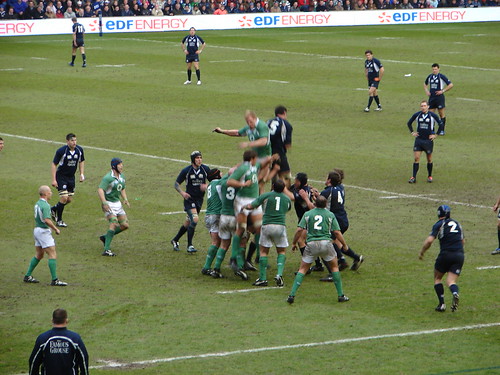
Week three of the RBS Six Nations saw Italy become unstuck by Wales, England keep alive their grand slam hopes by beating  a rejuvenated France, and Ireland prove that you can lose a match despite having 80% territory and possession as Scotland came away the surprise victors.

The weekend got under way in a wet and windy Rome with Wales under pressure from the start. The Italians barely left their own half and responded with a couple of penalties from fly-half Kris Burton, leaving the score at 6-9 at half time.

Full-back Lee Halfpenny was exemplary in his kicking display, and was a deserved man of the match. The first Welsh try was opportunistic, with Jonathan Davies capitalising on loose Italian defence. Throughout the game, Italy looked disjointed and only a shadow of the side that beat France so unexpectedly at the Stadio Olimpico.

The Azzuri were average in the face of the Welsh scrum – Martin Castrogiavanni was sin-binned for a scrummaging offence – and with Italy down to 14 men, Welsh winger Alex Cuthbert ran in a cleverly worked try aided by play from the middle by Mike Philips. A final score of 9-23 to Wales was representative of the entirety of the play that was in Wales’ favour, and showed their consistent potential lying second in the table and only two points behind England.

Later, the day saw England take on France at a freezing Twickenham. Tempers flared throughout the first half, giving weight to the age old Anglo-French rivalry.  They belied their inexperience to come back from 10-9 down at half time and a first half where England were clearly the weaker side.

France looked rejuvenated, with Fofana’s expertly worked try standing out as the highlight of the first half.  Parra had a neat game at fly-half, missing only a few penalties; his in-play decisions were well thought out. Tuilagi and Bastareaud provided power in the centre at the back for their respective sides. England were further helped when France took off some of their best players in exchange for the likes of Michalak and Szarzewski.

Tuilagi’s try came completely out of the blue, and proved to be the break that England needed with the score then standing at 20-10 in their favour. Despite missing a tricky conversion for Tuilagi’s try, Owen Farrell’s kicking and play making phases further illustrated why many believe he is the ‘new Jonny Wilkinson’. The match finished 23-13 to England.

French coach Philippe Saint-Andre conceded; “So many times we tried impossible offloads and lost the ball in the contact area. England didn’t do amazing things, but they were accurate and we were not accurate enough”.

England kept alive their hopes of a first Grand Slam in a decade, while France continue to languish at the bottom of the table with zero points – surprising considering their status as pre-tournament favourites, based on their form in the Autumn Internationals where they ran out impressive wins over Argentina and Australia.

Sunday saw the attention turn to Edinburgh. Scotland had never won back to back matches in the Six Nations before, and despite the Ireland side being ravaged by injury, they still entered the encounter as favourites.

Scotland spent much of the first half in their own half showing an impressive and consistent defence, with a total of 70 tackles made in the first 40 minutes.  Despite the domination, Ireland failed to capitalise on their chances, and at half time the score stood at 0-3, their only consolation a penalty by debutante fly half Paddy Jackson.

The Scottish lineout was impressive, capitalising on the height advantage given to them by the 6’9” Richie Grey. Despite going down to 14 men in the first half when prop Ryan Grant was given a harsh yellow card, Ireland seemed unable to break through.

The second half brought more chances for the Scots, with four penalties kicked by Laidlaw, and heavy pressure on the Irish touch line.  It was the Irish however who scored the one and only try of the match when Gilroy ran over from close range aided by a Rob Kearney pass, though Jackson missed the conversion.

Ireland spent the final 10 minutes practically encamped on the Scottish touchline but they were reckless and sloppy, making simple errors. The final score was 12-8 to Scotland, meaning they lie third in the table still with a chance of winning the tournament.

The competition returns in two weeks’ time with Scotland v. Wales, England v. Italy and Ireland v. France, which should be an interesting encounter given both sides experienced narrow losses this weekend.

The Six Nations continues on March 9.

Lucy Gibson

[poll id=”17″]

Six Nations: Week 2 Report

Scotland taking on Italy at Murrayfield. Photo credits to Daniel Richardson

Though the second round of fixtures in this year’s Six Nations championship failed to live up to the explosive start the tournament enjoyed a week ago, it nevertheless served up some intriguing results. England established themselves as favourites for the title with a well-fought victory in Dublin; Scotland gained an impressive win over Italy; whilst Wales showed immense character in overcoming a woeful French side in Paris.

Having beaten France in extraordinary fashion seven days ago, Italy now took on Scotland at Murrayfield and went into the game full of confidence with many people viewing them as favourites to grab only their second away win since they joined the championship in 2000. Scotland, in contrast, entered the fixture on the back of a convincing defeat at the hands of England in the opening week.

Come the final whistle, however, Scotland had produced a comfortable victory over the Azzurri courtesy of some clinical finishing and poor errors from the Italian side. Italy’s half-back’s, so effective and controlling against the French, crumbled under pressure from an exceptional Scottish defence and were unable to give their team any foothold in the game at all. By contrast, Greg Laidlaw and the Ruaridh Jackson were able to dictate play with both their kicking and running games. This culminated in Scotland scoring the opening try courtesy of a good finish by Dutch-born winger Tim Visser. At half-time the Scots led 13-3.

After the break Italy tried to get into the game, but what had worked last week in Rome was ending in simple errors here at Murrayfield. Matt Scott was able to score for Scotland after half-time with Laidlaw adding the conversion. Italy’s woes were summed up when fly-half Orquera butchered a certain try by throwing a pass that was intercepted by winger Stuart Hogg who ran eighty metres unopposed to touch down. Orquera was quickly substituted for Kris Burton, ending a dismal performance.

Italy were punished further when Lamont scored from turnover ball, and despite a consolation try for back-row Alessandro Zanni in the closing stages, there was little to cheer for the Italians. Scotland secured a 34-10 win that was as vital as it was impressive, largely through their fierce defence. They will hope to build on this in the next games.

The evening game on Saturday saw Wales travel to Paris to face a French side still reeling from their unexpected loss to Italy last weekend. Both sides had made losing starts to the campaign, and a lack of confidence was evident throughout the encounter. An extremely tight game was only settled by George North’s late try and saw Wales post their first win in eight games, and Rob Howley’s first since taking charge.

Defences were on top for the most part of the game and neither side was able to create many try-scoring opportunities. Wales engineered one, seizing it excellently and gaining the win their defensive work warranted. Both sides, usually noted for their extravagant running play, were understandably cagey in the first half and penalties from Michalak and Halfpenny made the score 3-3 at the break.

Both added another in the second half to make it 6-6 before a try finally came when North crashed onto a kick through by Dan Biggar to score in the corner. Halfpenny was able to add the conversion from the touchline, before also nailing a penalty and securing the Welsh victory by 16 points to 6.

The final game of the weekend saw England and Ireland take the field in Dublin. Both had secured impressive wins in their opening matches of the tournament and the winner here would undoubtedly be seen as the favourite to go on and win the tournament. The match was played in difficult conditions, and much of the play reflected this with no tries being scored for either side. England were ultimately able to master the situation better and played with greater composure and control than a vastly more experienced Irish side.

Throughout the encounter neither side looked like scoring a try and it was thus up to the boots of Owen Farrell and Ronan O’Gara (on for the injured Jonathan Sexton early in the match) to provide the points. Though Ireland were able to work themselves into promising positions on several occasions, basic handling errors prevented them from gaining real momentum.

Some of these errors were caused by the ferocious England defence, but the Irish will still be disappointed with their lack of composure when they entered England’s 22. Even Brian O’Driscoll, playing despite the birth of his first child earlier in the day, knocked-on under little pressure and conceded field position to England in the second half.

O’Gara and Farrell took the scores to 6-6 before England’s James Haskell was sin-binned in the 56th minute for deliberately playing the ball on the ground. Roared on by the Dublin crowd, this seemed to be the moment where the game would swing in Ireland’s favour. But some good defensive work and with Owen Farrell able to gain field position with his kicking game, England were able to weather the storm and go into what would prove to be an insurmountable lead.

Two penalties made it 12-6 to England, and this is how it stayed until the final whistle. Ireland can blame their inability to maintain their composure close to the English line for this defeat. England, however, put in a valiant and professional performance to earn their first win in Dublin for 10 years and mark themselves as favourites for the championship.

Sam Davies

Six Nations: Week 1 Report

France taking on Italy. Photo credits to Matteo Pieroni

The 2013 Six Nations Championship got off to an exciting start with wins for Ireland, England and Italy during the opening weekend.

The first match in Cardiff was an entertaining spectacle from start to finish as Ireland held off a spirited Welsh comeback to win 30-22. After announcing that this would be his final Six Nations earlier in the week, all eyes were on Brian O’Driscoll and he duly delivered by setting up the first try.

A lovely team move saw the ball spread left before O’Driscoll jinked past one defender and released Simon Zebo to score in the corner. This was converted by Jonny Sexton and he soon added another 3 points when debutant Andrew Coombs conceded a penalty in front of the posts.

Ireland smelt blood and soon surged even further ahead. Rory Best charged down a Dan Biggar clearance before releasing Jamie Heaslip who fed the ball to Zebo. He acrobatically kept the ball alive with a cheeky back heel and eventually fed Cian Healy to touch down and give his team a 20 point lead at the interval. When O’Driscoll crashed over from short range for his 26th Six Nations try, all looked lost for the Welsh as they trailed 30-3. However, the introduction of Justin Tipuric livened up the hosts and they soon had their first try on the board through Alex Cuthbert.

The tide had turned and pressure from Wales saw two Irish forwards sin-binned for ruck offences, creating an opening for the gap to be narrowed. Leigh Halfpenny obliged with a try in the corner before Exeter Chiefs prop Craig Mitchell also went over from close range. It was not enough however and Ireland held on for an important victory.

Despite dominating territory and possession, it was a disappointing day for Rob Howley’s men who have now lost eight successive matches and head to Paris needing a big improvement to challenge the French. Ireland host in-form England next and will have to replicate their first half performance to stand any chance.

England also got off to a winning start at Twickenham, putting in a clinical performance against Scotland. An Owen Farrell penalty gave the hosts an early lead but the crowd was soon silenced when Stuart Hogg pierced a gap in the defence to allow debutant Sean Maitland to score his first international try.

After both sides traded penalties, England took control of the match as the first half wore on. The forwards hard work paid off when Chris Ashton was able to charge over from close range. Farrell added the extras and another penalty to give his team a comfortable 19-11 lead at half time. After the break, it was the turn of Billy Twelvetrees to score on debut in a similar fashion to Ashton’s earlier effort. Farrell converted before spreading the ball wide for Geoff Parling to score in the corner.

Although Scotland hit back through a wonderful individual try from Hogg, it was England who had the final say as substitute Danny Care burrowed over in the final minute for a final score of 38-18. It was a dominating display from England to retain the Calcutta Cup and coach Stuart Lancaster expressed his delight with the result while stressing that they must ‘continue to build on it’ against Ireland next week. Scotland now head into their crunch match against Italy needing a victory to keep their hopes alive.

The biggest shock of the weekend came in Rome where Italy overcame fierce rivals to France to get their campaign off to a perfect start. The Azzurri got up and running after just five minutes as captain Sergio Parisse finished an excellent team move by going over in the corner for a converted try.

France hit back straight away as Louis Picamoles beat two defenders before barging over the line. The teams exchanged penalties before another excellent counter attack from France led to Benjamin Fall running in under the posts. A further conversion and penalty from the boot of Frederic Michalak meant his team led 18-13 at the interval.

The hosts came out strongly and were soon back ahead when Luciano Orquera offloaded beautifully to set up Martin Castrogiovanni before adding the extras. The lead was extended to 23-18 through a Kris Burton drop goal and this is how it stayed until the final whistle as huge amounts of French pressure could not find a way through a disciplined Italian defence.

It was an excellent start for Jacque Brunel’s side and they will now want to push on and prove more people wrong during the rest of the tournament. France on the other hand will need to do some soul-searching and regroup ahead of their big match against Wales. It was an excellent first weekend of action and hopefully the entertainment will continue for the rest of the tournament.

The Six Nations continues on February 9.

Simon Dewhurst

Six Nations 2013 Preview

Scotland and Ireland doing battle at Murrayfield. Photo credits to Paddy McCann

The Six Nations gets underway this weekend and it promises to be an exciting few weeks as the northern hemisphere’s finest fight for the title. The autumn produced some results that few would have predicted as reputations were both made and dented against the touring southern hemisphere sides. The next few matches offer a crucial chance for teams to set the foundations for the 2015 World Cup. With the Lions Tour to Australia on the horizon, this year’s tournament is perhaps the last chance for those eligible to play down-under to stake their claim for a place in Warren Gatland’s team. More pressingly, however, teams like England need to work on what they achieved in the autumn, whilst Wales and others will be looking to rebuild and move on from their dismal showings against southern hemisphere opposition. The tournament favourites must be France, but as form seems to mean very little to the French, the championship could be extremely open.

Wales

The Welsh come into the tournament off the back of a truly awful autumn campaign in which they lost every match they played and looked a complete shadow of the side that won the Grand Slam in last year’s tournament – vast improvement will be necessary if they are to replicate that achievement. Wales will be hoping that Dan Biggar is able to bring his regional form into the national side and perhaps reignite their faltering backs.

There is no doubting Wales’ quality, particularly in the backline where they have previously combined power and speed to devastating effect. Yet what they seemed to be lacking in the autumn was a sense of self-belief. No doubt the absence of Warren Gatland had something to do with that, and they will miss him again this tournament. If they are to challenge for the title a strong start will be necessary to reinvigorate the squad and get back some of that lost confidence. With this in mind, their first game against Ireland at the weekend may prove vital to their performance over the whole tournament: win it and that self-belief may come streaming back, lose it and the prospect of facing France, Italy and Scotland away from home begins to look extremely daunting.

Prediction: 2nd

England

England will fancy their chances this time around having ended the All Blacks twenty match unbeaten run at Twickenham two months ago. That was an exceptional performance, and if they can repeat that for five games, they will easily win the Grand Slam. Though not impossible, it’s nonetheless improbable. Though England took apart the world champions in the autumn, they also lost to both Australia and South Africa, and Stuart Lancaster has been quick to dismiss the effect of that win over New Zealand. What is guaranteed is that the win in the autumn has put the squad under expectations that they have not experienced under Lancaster so far.

The last twelve months has seen improvement from this England side, but it has not been vast. Since Lancaster took over they have won six, lost five and drawn one of their 12 games. An opening game against Scotland is a good fixture for England to begin their championship, and assuming they win that they should be able to push on and have a decent tournament. Though a Grand Slam seems unlikely, if England managed to channel some of the performance against New Zealand into the next few matches then they may well be able to mount a title challenge.

Prediction: 3rd

France

The tournament favourites have a squad full of quality and depth in most positions; with this in mind anything less than a tournament win would be a failure for Les Bleus. Under Philippe Saint-Andre, the squad is much more settled and have been rewarded for this with results. In the autumn, the French crushed Australia and easily defeated Wales’ conquerors Samoa. Those results showed that perhaps this French side can be consistently excellent rather than sporadically spectacular.

Much will depend on the form and, perhaps more importantly, the mood of fly-half Freddie Michalak. At his best there are few better and he is capable of winning games on his own. At worst he is a drag on the entire squad and prone to sloppy errors. The mercurial ten will need to perform if France are to fulfill their grand potential in the coming weeks. Having only managed fourth place last year, this time out the French crowd are likely to have much more to cheer about.

Prediction: 1st

Ireland

Like Wales, Ireland had a pretty wretched time in the autumn and coach Declan Kidney is under considerable pressure to get some good results soon. Their tournament could rest on the outcome of their first match this weekend against Wales in Cardiff. If Ireland pick up a couple of wins from their first two games they have the capability to win the tournament – this is a big ‘if’, however.

One big factor that should raise Irish hopes is the return of the talismanic Brian O’Driscoll, the most experienced player in the Six Nations. Though he has not been given the captaincy (that honour has remained with Jamie Heaslip) his leadership as much as his considerable skill-set will reinvigorate the squad no end. Despite his return, the Irish side could still have a difficult tournament if they do not get off to a good start. This could ultimately cost Kidney his job.

Prediction: 4th

Scotland

The last 12 months for Scotland have been something of a roller-coaster ride. Having lost all their games in the Six Nations last year, they managed three victories from three in the southern hemisphere in the summer, including a sensational victory over Australia, before they recorded three autumn defeats, the last coming against Tonga. This was enough to force Andy Robinson to resign as head coach and has left the team with lots to think about as they go into their game with England at Twickenham this weekend.

Scott Johnson has taken over from Robinson and will hope to give the Scots the attacking edge they have always lacked, as well as restoring their confidence in themselves. In fifteen games in the Six Nations under Andy Robinson, Scotland managed only two wins and a draw. All the signs point to a similar story this year. They begin with a daunting trip to Twickenham and will likely struggle to find any solace except against Italy who they will expect to beat. The lack of expectation may help Scotland spring a surprise, but it is more likely that dearth of attacking talent will be their undoing once again.

Prediction: 5th

Italy

The Italians will hope that teams freeze in Rome and they are able to surprise a few with their abrasive style. Sergio Parisse is their one world class player and he will lead from the front as he always does. Trips to Italy for Wales and Ireland may prove difficult if they do not bring their ‘A’ games, but the expectation is that the Italians can eventually be worn down and their frail backline exposed by quick rugby.

Italy will undoubtedly target their game with Scotland as the one to win. This is exactly what they did last year when they avoided the ‘wooden spoon’. But this year that fixture will take place at Murrayfield, and it is for this reason that it is likely the Azzurri will finish bottom of the pile.

Prediction: 6th

Sam Davies