On March 6, it was the semifinal game against Leeds Met, who was the finalist last year after narrowly beating Exeter 19-10 on neutral ground. With regards to the last time the teams competed against each other, Exeter were determined not to have the past repeat itself.
Right from the start, both teams brought forth hard hitting tackles and rucks. Leeds placed a lot of pressure on Exeter in their territory in the first few minute, but the tide soon turned in Exeter’s favour after an excellent scrum from Exeter’s forward pack, stealing the ball from a Leeds’ put in.
Exeter forwards dominated the set pieces and rucks, creating great platforms for the backs to work off. After 17 minutes of hard work, an excellent scrum at the 5m line led to fly half Lucy Demaine crashing through the opposition and putting Exeter on the scoreboard first.
The visitors did not drop their heads, but instead stepped up their game and got a successfully converted try just minutes after. This was followed by a series of handling mistakes from both sides, as the anxiety to put points past the opposition increased. Exeter did not take long to compose themselves, and got the lead back as Clara Nielson crashed through Leeds’ defence a minute before halftime.
HT: EUWRFC 10 – 7 Leeds Met Carnegie 1st
The second half started off similarly to the first, seeing hard hitting scrums, rucks and mauls from both sides. It was obvious, however, that fatigue had caught up with the visitors’ forward pack, as one after another went to ground after each scrum.
Exeter continued their relentless attack from the end of the first half and Prop Sarah Lambson extended the lead with a try in the 58th minute, successfully converted by Lucy Demaine. Leeds Met fought back hard, but Exeter strengthened their defence and rendered the visitors’ attacking attempts unanswered until the very last play – the second half ended with a converted try by Leeds Met.
FT: EUWRFC 17 – 14 Leeds Met Carnegie 1st
Exeter had worked hard to contain the determined opposition’s waves of attacks and emerged victorious – securing in the place in the BUCS final against Cardiff Met.
Wales head into their final game with a slender hope of taking the title. Photo credits to Simone Ramella
After the break last weekend, the Six Nations returned with Scotland hosting a resurgent Wales, France still hoping for their first win of the tournament against Ireland, and England hoping to keep their Grand Slam hopes alive with a win against Italy on Sunday.
The first match of the weekend saw Scotland take on Wales in wet and miserable weather. It was perhaps little surprise then that the match was dominated by penalties, mistakes, and the sound of referee Craig Joubert’s whistle. In fact, the game is likely to be remembered more for setting a new record for the number of penalties in a Six Nations match than for any of the rugby on show.
The first half was dominated by the boots of Leigh Halfpenny and Greg Laidlaw, and they traded blows until Wales managed to take one of the few try-scoring opportunities they created. A powerful break by George North was carried forward by the Welsh pack, and after some sustained pressure on the Scottish line, Hooker Richard Hibbard was able to force his way over.
The second half was not much of an improvement and Halfpenny continued to rack up points for Wales, 23 of them in all. Ultimately, this proved to be the difference between the sides as Scotland failed to keep their discipline. A forgettable game ended 18-28 to Wales, who kept their weak title hopes alive.
Ireland then took on France in an infinitely more exciting encounter in Dublin. The French fought back from 13-3 down at half-time to score ten unanswered points and snatch a deserved draw.
The first half saw Ireland dominate for long periods, and they were rewarded when captain Jamie Heaslip went over following a devastating maul by his fellow forwards. This and the boot of youngster Paddy Jackson, in for the injured Jonathan Sexton, saw Ireland take a commanding lead at the break.
This proved not to be enough, however, as France pressed in the second half against an increasingly lethargic Irish side. Outstanding number-eight Louis Picamoles forced his way over the line from close range late on to bring France within two points of drawing level. Fly-half Freddie Michalak then held his nerve to land the vital conversion which drew them level. France are still looking to avoid a last place finish in the competition, but this result will certainly give them heart going into next week’s game with Scotland.
Italy made the trip to Twickenham for the final game of the weekend, with England looking to continue their march to a first Grand Slam in ten years. Expectations suggested a walk-over for the English, but it proved anything but. Ultimately, the boot of Toby Flood, replacing the injured Owen Farrell, gave England a hard-fought victory over an organised Italian side.
At half-time England had a comfortable 12-3 lead, but a second half try from Luke MacLean and kicks from fly-half Luciano Orquera made it a tense finale. Flood’s penalties were enough to see England home, but not without having to defend stoutly against Italy in the closing stages. England were ultimately able to keep their Grand Slam hopes alive as the match finished 18-11 in their favour.
The Six Nations tournament reaches its conclusion this weekend (March 16-17).
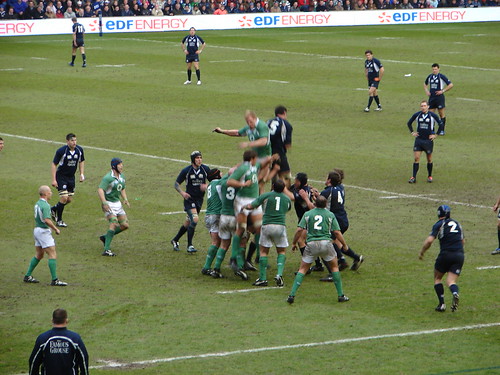
Scotland and Ireland battling it out. Photo credits to Paddy McCann
Week three of the RBS Six Nations saw Italy become unstuck by Wales, England keep alive their grand slam hopes by beating a rejuvenated France, and Ireland prove that you can lose a match despite having 80% territory and possession as Scotland came away the surprise victors.
The weekend got under way in a wet and windy Rome with Wales under pressure from the start. The Italians barely left their own half and responded with a couple of penalties from fly-half Kris Burton, leaving the score at 6-9 at half time.
Full-back Lee Halfpenny was exemplary in his kicking display, and was a deserved man of the match. The first Welsh try was opportunistic, with Jonathan Davies capitalising on loose Italian defence. Throughout the game, Italy looked disjointed and only a shadow of the side that beat France so unexpectedly at the Stadio Olimpico.
The Azzuri were average in the face of the Welsh scrum – Martin Castrogiavanni was sin-binned for a scrummaging offence – and with Italy down to 14 men, Welsh winger Alex Cuthbert ran in a cleverly worked try aided by play from the middle by Mike Philips. A final score of 9-23 to Wales was representative of the entirety of the play that was in Wales’ favour, and showed their consistent potential lying second in the table and only two points behind England.
Later, the day saw England take on France at a freezing Twickenham. Tempers flared throughout the first half, giving weight to the age old Anglo-French rivalry. They belied their inexperience to come back from 10-9 down at half time and a first half where England were clearly the weaker side.
France looked rejuvenated, with Fofana’s expertly worked try standing out as the highlight of the first half. Parra had a neat game at fly-half, missing only a few penalties; his in-play decisions were well thought out. Tuilagi and Bastareaud provided power in the centre at the back for their respective sides. England were further helped when France took off some of their best players in exchange for the likes of Michalak and Szarzewski.
Tuilagi’s try came completely out of the blue, and proved to be the break that England needed with the score then standing at 20-10 in their favour. Despite missing a tricky conversion for Tuilagi’s try, Owen Farrell’s kicking and play making phases further illustrated why many believe he is the ‘new Jonny Wilkinson’. The match finished 23-13 to England.
French coach Philippe Saint-Andre conceded; “So many times we tried impossible offloads and lost the ball in the contact area. England didn’t do amazing things, but they were accurate and we were not accurate enough”.
England kept alive their hopes of a first Grand Slam in a decade, while France continue to languish at the bottom of the table with zero points – surprising considering their status as pre-tournament favourites, based on their form in the Autumn Internationals where they ran out impressive wins over Argentina and Australia.
Sunday saw the attention turn to Edinburgh. Scotland had never won back to back matches in the Six Nations before, and despite the Ireland side being ravaged by injury, they still entered the encounter as favourites.
Scotland spent much of the first half in their own half showing an impressive and consistent defence, with a total of 70 tackles made in the first 40 minutes. Despite the domination, Ireland failed to capitalise on their chances, and at half time the score stood at 0-3, their only consolation a penalty by debutante fly half Paddy Jackson.
The Scottish lineout was impressive, capitalising on the height advantage given to them by the 6’9” Richie Grey. Despite going down to 14 men in the first half when prop Ryan Grant was given a harsh yellow card, Ireland seemed unable to break through.
The second half brought more chances for the Scots, with four penalties kicked by Laidlaw, and heavy pressure on the Irish touch line. It was the Irish however who scored the one and only try of the match when Gilroy ran over from close range aided by a Rob Kearney pass, though Jackson missed the conversion.
Ireland spent the final 10 minutes practically encamped on the Scottish touchline but they were reckless and sloppy, making simple errors. The final score was 12-8 to Scotland, meaning they lie third in the table still with a chance of winning the tournament.
The competition returns in two weeks’ time with Scotland v. Wales, England v. Italy and Ireland v. France, which should be an interesting encounter given both sides experienced narrow losses this weekend.
France taking on Italy. Photo credits to Matteo Pieroni
The 2013 Six Nations Championship got off to an exciting start with wins for Ireland, England and Italy during the opening weekend.
The first match in Cardiff was an entertaining spectacle from start to finish as Ireland held off a spirited Welsh comeback to win 30-22. After announcing that this would be his final Six Nations earlier in the week, all eyes were on Brian O’Driscoll and he duly delivered by setting up the first try.
A lovely team move saw the ball spread left before O’Driscoll jinked past one defender and released Simon Zebo to score in the corner. This was converted by Jonny Sexton and he soon added another 3 points when debutant Andrew Coombs conceded a penalty in front of the posts.
Ireland smelt blood and soon surged even further ahead. Rory Best charged down a Dan Biggar clearance before releasing Jamie Heaslip who fed the ball to Zebo. He acrobatically kept the ball alive with a cheeky back heel and eventually fed Cian Healy to touch down and give his team a 20 point lead at the interval. When O’Driscoll crashed over from short range for his 26th Six Nations try, all looked lost for the Welsh as they trailed 30-3. However, the introduction of Justin Tipuric livened up the hosts and they soon had their first try on the board through Alex Cuthbert.
The tide had turned and pressure from Wales saw two Irish forwards sin-binned for ruck offences, creating an opening for the gap to be narrowed. Leigh Halfpenny obliged with a try in the corner before Exeter Chiefs prop Craig Mitchell also went over from close range. It was not enough however and Ireland held on for an important victory.
Despite dominating territory and possession, it was a disappointing day for Rob Howley’s men who have now lost eight successive matches and head to Paris needing a big improvement to challenge the French. Ireland host in-form England next and will have to replicate their first half performance to stand any chance.
England also got off to a winning start at Twickenham, putting in a clinical performance against Scotland. An Owen Farrell penalty gave the hosts an early lead but the crowd was soon silenced when Stuart Hogg pierced a gap in the defence to allow debutant Sean Maitland to score his first international try.
After both sides traded penalties, England took control of the match as the first half wore on. The forwards hard work paid off when Chris Ashton was able to charge over from close range. Farrell added the extras and another penalty to give his team a comfortable 19-11 lead at half time. After the break, it was the turn of Billy Twelvetrees to score on debut in a similar fashion to Ashton’s earlier effort. Farrell converted before spreading the ball wide for Geoff Parling to score in the corner.
Although Scotland hit back through a wonderful individual try from Hogg, it was England who had the final say as substitute Danny Care burrowed over in the final minute for a final score of 38-18. It was a dominating display from England to retain the Calcutta Cup and coach Stuart Lancaster expressed his delight with the result while stressing that they must ‘continue to build on it’ against Ireland next week. Scotland now head into their crunch match against Italy needing a victory to keep their hopes alive.
The biggest shock of the weekend came in Rome where Italy overcame fierce rivals to France to get their campaign off to a perfect start. The Azzurri got up and running after just five minutes as captain Sergio Parisse finished an excellent team move by going over in the corner for a converted try.
France hit back straight away as Louis Picamoles beat two defenders before barging over the line. The teams exchanged penalties before another excellent counter attack from France led to Benjamin Fall running in under the posts. A further conversion and penalty from the boot of Frederic Michalak meant his team led 18-13 at the interval.
The hosts came out strongly and were soon back ahead when Luciano Orquera offloaded beautifully to set up Martin Castrogiovanni before adding the extras. The lead was extended to 23-18 through a Kris Burton drop goal and this is how it stayed until the final whistle as huge amounts of French pressure could not find a way through a disciplined Italian defence.
It was an excellent start for Jacque Brunel’s side and they will now want to push on and prove more people wrong during the rest of the tournament. France on the other hand will need to do some soul-searching and regroup ahead of their big match against Wales. It was an excellent first weekend of action and hopefully the entertainment will continue for the rest of the tournament.
England slumped to a 20-14 defeat at the hands of a more precise Australian side. Having led at the break, England failed to register any points in the second half despite piling pressure on Australia in the latter stages of the match.
A try from winger Nick Cummins and Berrick Barnes’s goal-kicking was enough to give the Wallabies their victory and see them bounce back from their 33-6 thrashing by France in spectacular fashion.
Some suspect decision-making from captain Chris Robshaw saw England choose to run a number of kickable penalties in the second-half that would have at least drawn the game.
In their new purple kit, England showed many of the same attributes that won them games in the Six Nations earlier this year, but crucially lacked the accuracy and precision that seems to set apart the southern hemisphere sides.
A tentative first half-hour saw Australia dominate both territory and possession; they were aggressive at the ruck and managed to create some quick ball for their injury depleted backline. Barnes and Flood traded blows as England managed to open up a 9-6 lead in the 33rd minute despite being second best overall.
The final minutes of the half saw the match explode into life. First, Cummins was able to dash over in the corner after a good break from scrum-half Nick Phipps. The Twickenham crowd felt there may have been a hint of a forward pass in the build up, but what came next more than evened things up. Following Danny Care’s quick tapped penalty, Tuilagi latched onto an off-load from centre partner Brad Barritt and managed power up to the line in the corner.
The decision went to the video referee, who adjudged the ball to have hit the line by what could only have been a matter of millimetres. That controversial try gave England a rather undeserving 14-11 lead at the break, as neither Barnes nor Flood could add conversions to their teams’ tries.
If the first-half had been largely tentative, the second was pulsating. Australia began with much greater urgency and pinned England back in their own half. Twelve second half minutes saw the men in purple barely touch the ball as Australia racked up nine unanswered points from the boot of Barnes.
Much had been made of England’s supposed dominance at the scrum, but Aussie props Ben Alexander and Benn Robinson more than held their own and forced two penalties that prompted England coach Stuart Lancaster to replace the under pressure Joe Marler with the inexperienced Mako Vunipola.
Six points down with thirty minutes to go, England finally came to life. The substitutes Joe Launchbury and Vunipola reinvigorated the team and they set about attempting to make up the deficit.
First Ashton was forced into touch two metres short following excellent work by Launchbury under a high ball; then England kicked to touch twice rather than taking the points. Whilst this had worked in the first half, with Danny Care’s quick tap to put Tuilagi over, this time the video referee correctly judged Thomas Waldrom to have knocked-on when he stretched to put the ball down.
Australia’s defence was rock solid and Michael Hooper, deputising for the injured David Pocock, was exceptional in disrupting England’s ball and winning turnovers, as well as making numerous important tackles.
Though England continued to press for an opening, simple errors continually halted their momentum. Passes didn’t go to hand, forwards failed to secure ball at the breakdown and malls resulted in obstruction. Australia were able to hold out and claim a well-deserved win and some respite from the criticism they have received over the last week.
England now face the daunting task of playing South Africa and then New Zealand in the next two weeks. Though they created the necessary chances to win this game, England ultimately lacked the precision and accuracy to sustain pressure long enough to gain the necessary points against an under strength Australian side. Robshaw and his team will rue their decisions not to take the points on offer from their penalties.




 exeposedev