Tag Archives: Violence

Chess – Creative Fridays

In the first short story of the term, David Volco tells an absorbing tale of grief and anger…


Chess-king


Chess


I


At work once we got told that in thirty of our stores traces of faecal matter were found in a particular cream cake and that we were probably going to be facing heavy lawsuits. We didn’t even make those cakes – they’re bought from a French catering company. We’re a department store, is it really our responsibility to check every almond sprinkle for a harmless strain of bacteria? I had one of those cakes just a few days prior to the announcement, in the cafeteria. Kathy was too tired to make my lunchbox the evening before. The cake was fine. I guess I must’ve ingested some faecal matter. It all comes out the same though. Kathy grimaced when I told her that. She told me to go out for a walk, “get outside your own head for a while”. She wasn’t even aware of the concept of dualism but it was inherent in her advice.

In the cafeteria, Samuel had joined me mid-meal. I remember his skin was particularly troubled – it had that braised look about it, as if one scratch would leave a messy scar. He was clutching a faded, labelled Tupperware. “Hello”, he said without sitting down.

“Alright, Samuel.”

“Mind if I…?”

Deliberately, I remained silent for as long as I could bear. The trouble with Samuel is he doesn’t realise how likeable he could be, were he to just snap out of his timid ways. Instead he shuffles around the place, and as far as I can tell he talks only to me and a janitor who takes advantage of his eagerness by recounting his lifetime of conquests, sexual and physical. Samuel’s so used to others leading the situation (goodness knows how he got to head office) that his comfort with silence massively excelled the apparently taxing act of completing his sentences. Someone dropped a pile of trays in the kitchen.

“Sure”, I said, breaking a tension that only existed for me. Samuel plopped into his seat like a grape.

Now that we were on the same plane, we held a more amicable silence for some time. Samuel unravelled quite an astonishing amount of cling film from his ham sandwiches. With my career cramming against Kathy’s illness in my head, it was actually quite nice to watch him work through his meal. I realised then and there in fact that I knew almost nothing about him, and was overcome with an almost scientific desire to inspect this Hobbit-like man who’d wandered the same carpet as me for almost eight years now. My spontaneous inquiry made me cringe a little inside.

“What makes you tick, Samuel?”

He looked up at me as if I was a piece of furniture that had suddenly coughed. “What do you mean?”

I reined in my joviality. “Just, do you have any hobbies? Interests?” This was Samuel, not Gandhi – I was the leader of this encounter. A piece of my infected cream cake dripped onto the table. Samuel eventually responded, “Well, I quite like chess I suppose.” Then he leaned forward, and with his forefinger he scooped up the cream cake globule and popped it into his mouth.


II


Every Thursday Samuel and I played chess in the office until we were asked to leave. I’ll admit that I relished the envy in the janitor’s eyes as we passed him silently by. We played with a wooden set that Samuel had made himself some years before. He described how he had selectively stained the wood, and how each pawn was slightly different. He talked more than anything about the varnishing. “It makes the difference”, he used to say, “makes it look professional.” Mostly though, we didn’t speak. And that was good. Kathy got suspicious when I decided against inviting Samuel round for dinner, as if I would cheat on a sick woman. Really though I recoiled against the idea of being in the same room as two such conflicting silences.

Samuel’s chess was good. Very good, in fact. He played a bit like a computer, building up his pieces with no obvious objectives other than sealing off any chance of attack, and eventually he’d find an opportunity and flood through it like a tidal wave. Over the weeks and months, though, I learnt to counter this, sacrificing pieces to prevent his constructions ever getting off the ground. I found myself thinking and rethinking positions at work, in the car, and when Kathy had to stay in the hospital I sat with a chess app on my phone going over variations. Father Dibson, who visited more than I did, helped me practise by her bed.

The first time I beat Samuel – our seventeenth game – I actually jumped out of my chair. He smiled and ran his hands through his hair. “That was really something.” The janitor, who had taken to watching our games despite not knowing the first rule of chess, shook my hand enthusiastically.

That same evening, after a few beers around mine in a subdued ‘celebration’, Samuel and I were watching TV. A snowstorm had started up outside, and we were both excited at the prospect of a Friday off work, though neither of us dared jinx it. A man on the TV was talking about the planning of the world’s tallest building. “At over a kilometre high, the Kingdom Tower will dominate the skyline of Dubai.”

“Aren’t you married?” Samuel asked.

“Yes.”

“In 2008, proposals were made for a mile-high building, but this had to be scaled back…”

“Why do you ask?”

“Oh, no, no reason.”

There was clearly a reason. Samuel and I had gotten close in the months of chess and cafeteria meals. He had obviously noted the dwindling supply of my lunchboxes, and the general untidiness of the flat. Never had he initiated any conversation of depth, until now. Perhaps it was the beer. “It’s just-”

“I’m currently flying at the exact height the Kingdom Tower would reach, and my goodness me!”

“-is your wife on holiday or something?”

“No, she’s in hospital.” I stretched back in my armchair in preparation for a lie. “I visit her a lot.”

“I can’t even begin to imagine what it would be like to fall from such a great height!”

At that moment, my phone rang. It was Doctor Cowper.


III


443885503_570de53c73_oKathy looked like an alien. Her cheekbones were tent poles beneath her skin, which flaked and sagged like papyrus. Her eyes bulged and an unhealthy pulse was visible in her neck. It took her a while to recognise me, and to my surprise she smiled. I hadn’t visited in three weeks.

“She can’t talk.” Father Dibson stood up from her bedside.

“How long has she got?”

“It’s hard to predict these things, what matters-”

“George – please.” He scratched his head and turned around to look out the window at the snow.

“The doctors say it’s a matter of hours.”

I once more found myself in silence for some time. My fingers trembled. Dibson read his bible and his smartphone, never intruding. I could smell the beer on my breath, so eventually I went to get coffee. The place was built like a maze, with every sign repeated in twelve languages, a labyrinthine cement block of white-washed corridors that looped through fucking wormholes into themselves, and me wobbling down the squeaky floors stained by the dying. I burst into a toilet and threw up violently.

There, with my head in the bowl, I spent a long time thinking. I put myself in Kathy’s shoes, losing my bodily functions one by one. Walking, then talking, then pissing with assistance. Even eating was a chore for her. And every step of the way I was assuredly telling her – telling myself that it was temporary. How lonely this hospital is. And I was off playing chess with a fucking hermit.

I heard chaos before I got back in the room. Kathy was convulsing, and a machine by her bed bleeped and squealed on her behalf. A nurse ran in after me and fiddled with her equipment. “What’s going on?” I asked, but she kept telling me to calm down. Calm the fuck down! “Is this it? Tell me is this it?” Dibson clutched his bible, like this pandemonium was some initiation into a higher realm of understanding. The machines squawked in our little room as the nurse called out for assistance but we were lost in the stomach of the leviathan. I wondered how many people had died in that room. What was dying even like? I don’t know anything about dying, about really dying and knowing that’s what’s happening. I whimpered at Kathy’s spasms and the smell of urine and Dibson clasped his book tighter like a ship’s captain being subsumed.

Suddenly everything went still. The nurse gave us the look. Father Dibson slowly crossed the room, paused, and hit the window.

I did nothing.

Kathy died at 10:30PM exactly on the 14th of April. The paperwork necessary was over in an hour, but Dibson and the staff urged me to “take all the time you need to come to terms with this.” By 11:45 I was in The Horse and Chains, on my second pint. I’d had my reflections. I wanted to get outside my head, and I must have succeeded because I hardly remember anything. I drank alone. The snow picked up and I must’ve walked back, heavy and warm from booze. I remember being very wet when I finally got there. Samuel was still about, waiting.

I remember hating him for his innocent questioning, for his chess and his childish glasses. I hated him for his raincoats and old jeans and Doctor Who novels and I wished he would leave, but it was way past midnight and freezing. Frustration and anger sloshed around inside me and before I knew it I’d punched him hard in the stomach. He fell, and I felt a brief release. I kicked his crotch and straddled him, and inched freer. I was so ready to pummel his face into a mess, to escape completely – his ridiculous virgin face, his blood held back by millimetres of crusty skin that I was going to rip off because “Fuck you Sam!” I smacked his chest. “Fuck! You!”

I paused to catch my breath, and saw him crying. I stood. My head span. “Get the fuck up.” I was slurring. He curled into a ball and whined. “Get the fuck up you…” but it was too late, and I glimpsed the crimson stain around the groin of his jeans and recoiled. I must’ve kicked harder than I thought. My passion faded. Briefly I stumbled about the flat, drunk, my hands over my mouth, looking for some kind of solution. He trembled like a deer.

Outside, the snow continued to build.

The sun encroached on the horizon, and dogs began to bark.


I passed out on the couch.


David Volco

Leave a comment below or write to Books at the Facebook Group or on Twitter!

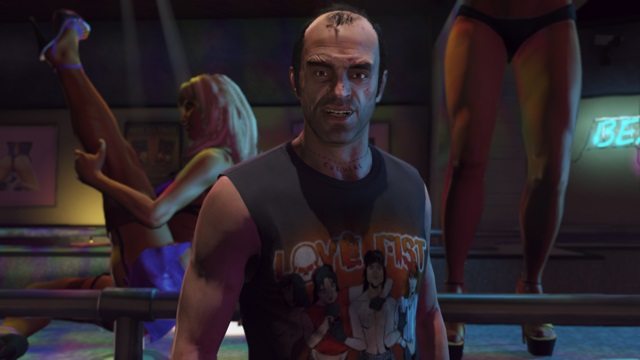
Sexism in Video Games: GTA V

The recent release of Grand Theft Auto V has placed the spotlight, yet again, on sexism and how females are portrayed in video games. Face it, when you think about video games, you also share the same stereotypical view that they have a male-orientated target market; however, in a recent poll, it was recorded that 45% of video gamers are female. With growing options to play as a female protagonist, male orientated games may be a thing of the past.

It’s not surprising that the currently recorded sales for GTA V in the UK is over 2.6 million. This is no wonder, since it gives you the freedom to explore a huge map in any way that you like, doing anything from riding a motorbike off the top of a cliff to killing provocatively dressed females with an RPG. The one thing that GTA lacks, however, is a female lead. Instead, we’re presented with three strong male protagonists, a bank robbing ‘family man’, a town drunk and a man rebelling away from everyday life.

What GTA lacks in strong females, other recent games make up for. The hugely popular Tomb Raider, portrays Lara Croft as a physically strong yet vulnerable character that all players are able to relate to. Tomb Raider has been a successful franchise for over 17 years, creating a worldwide recognisable figure which fans have grown to love, resulting in films and merchandise being made.

Admittedly, this is rare for lead females—even though they may not be the main focus, they play a vital part in the storyline, which is evident in games, such as The Walking Dead. Clementine is an emotionally vulnerable young girl who is completely dependent on you, therefore making her vital to the storyline. Although she may not be the lead character, you end up becoming emotionally attached and caring more for her than you do for yourself.

These are just two examples where females are important to the storyline and bring more to it than just a pretty face.

Clementine – The Walking Dead

Nevertheless, if you long to play as female, you can! Recently, more games are breaking the mould, giving the player a choice of characters to play as, such as in Mass Effect 3, Dead Island and Resident Evil—just to name a few. However, at the E3 gaming convention, Microsoft unveiled a variety of games for their upcoming console, of which its developers have demonstrated doubt to risk making the lead character a female. Even so, it is proven to have been a huge money-making success.

Most female characters are aesthetically attractive—perfect for the male gamer; however, for the other 45%, seeing Lara Croft in tight wet clothing is really necessary. Maybe having the option could make everyone content?

In any case, does the sex of the protagonist really matter? It wouldn’t change the enjoyment of the game or its success If anything, it would make it stand out from the crowd and show that the developers are actually doing something about the growing sexism in games, which has so far been GTA’s biggest criticism.


Adam Turnbull

Are football fans bringing shame to our country?


Millwall fans fighting with the police at Wembley. Photo credits: Darren Staples/ Reuters

This weekend, football found its way back into the headlines for all the wrong reasons. An FA Cup semi final between Millwall and Wigan was marred by widespread fan violence, while Newcastle’s 3-0 defeat at home to Sunderland was followed by “scenes reminiscent of the dark days of football riots” in the centre of Newcastle. All in all, this was “football’s weekend of shame”.

If you solely read the Daily Mail, and were a total idiot, you’d blindly accept that opening paragraph as the absolute truth. The reality is far less sensational, and far less likely to sell newspapers to people whose view of football culture remains tragically prehistoric.

While this violence has been rightly condemned, it’s vital to get some perspective on what actually happened over the weekend. Some people got hammered, decided that gesturing at men in a neon jacket and a funny hat was a good idea, and went too far with the abuse. In other words, what happens every weekend all over the country every Saturday night. The fact that these people did so while masquerading under the comfortable stereotype of football fans is no reason to assume that these incidents had anything more to do with football than your average post-nightclub fight has to do with the perpetrator preferring Skrillex to say, Rihanna.

The guilty parties in Newcastle weren’t even at the match (the “riots” happened on the other side of the city). Blame the pubs that opened at 8am so people could still get boozy before the big game, don’t accuse the people who paid good money to actually go and support their team. Wonder instead what made those sneering youths so disenfranchised with society that they felt the need to throw beer bottles at the police from behind their balaclavas; it’s complacent and wrong to assume that this is solely football’s fault.

Granted, the violence at Wembley was more troubling. Millwall, a club with a fraught history of fan disorder in the 1970s and 1980s, should never have put tickets on general sale. After a series of incidents in the late 20th Century, perpetrated by yobs for whom the main (only) attraction of football matches was the chance to punch people from other towns under the guise of fandom, the club cleaned up their act. Banning orders were issued, travelling fans were policed more rigorously, and statistics fell into line with other clubs. To undo that work in a stroke designed to sell more tickets was stupid; the banned could come back into the fold, their desire to cause trouble barely dampened by ten years of enforced exile.

The resulting images show a few people fighting, faces contorted with rage, while everyone else looks a bit bemused. Despite the outraged headlines, 12 Millwall “fans” were arrested at Wembley on Saturday, and eight people in total were arrested in St. James’ Park on Sunday. That’s twenty people out of nearly 140,000 who attended those two matches. 0.0001% of those who attended the two games, not withstanding the tens of other games that took place over the weekend. Even for the most pious amongst us, that surely cannot constitute a “weekend of shame”. For perspective, 152 people were arrested at last year’s Notting Hill Carnival, described by police as “trouble-free”.

Football undoubtedly has an image problem. Post-London 2012, footballers are overpaid, arrogant, and cheats, especially compared to the apparently saintly Team GB. Imagine if Steven Gerrard had sworn at the media like Bradley Wiggins did after being papped following a crash last year. There would have been outrage, not understanding.

That’s not to say that the beautiful game doesn’t have an ugly side. Racism controversies have been splashed all over the ‘papers, while fans of rival teams still retain the capacity to be utterly vile to one another. People behave differently in football stadiums to how they do on the street. You could, however, say the same thing about nightclubs; I don’t know about you, but I’ve never whipped out the robot at a bus stop.

It’s also unfortunate that this weekend’s events happened so close to the death of Margaret Thatcher, a woman whose tenure as Prime Minister has become synonymous with the grossly unjust cover-up of the Hillsborough disaster, as well as ill-fated plans to demonise football fans by issuing them with compulsory ID cards.

If you believe certain sections of the right-wing media, who have spent a week eulogising about Lady Thatcher, one of the most divisive leaders in British history, then her stark views on football fans have been vindicated. That’s simply not true. Football these days is a safe, comfortable entertainment industry, or as safe and comfortable as anything can be in England in 2013. Football and its fans are merely a reflection of the issues that trouble a nation not only struggling with severe financial difficulties, but also dealing with some of the most sweeping social and cultural reforms in its history. Dissatisfaction is inevitable.

If anything sums up the storm in a teacup that was this last weekend, then it’s the image that many newspapers carried to demonstrate the scale of the violence. This image showed a man attempting to punch a horse. Having attended several games across the country, from Hull to Exeter via quite a lot of places inbetween, I can safely say that football fans are not generally like this. No amount of legislation or outrage will ever stop someone from being *that* much of an idiot.

Owen Keating, News Editor

Students accused of assaulting local man escape prosecution

Mr. Walden uploaded the photo to facebook on April 1, stating "the justice system works for you if you come from a wealthy background"
Mr. Walden uploaded the photo to Facebook on April 1, stating “the justice system works for you if you come from a wealthy background”

A man who was assaulted by a group of men he identifies as students of the University of Exeter has been told by the justice system that no charges will be brought to those responsible.

Gary Walden has been told by the Crown Prosecution Service that there is not enough evidence to prosecute, following an assault he attained on a night out last November. Mr. Walden was attacked by a group of five men he identified as University of Exeter students, sustaining a fractured cheekbone and cuts and bruises across his face that required two days of hospital treatment.

A photo was published to Facebook on April 1 by Mr. Walden depicting his injuries in a plea to help identify those responsible, after he had been advised by Devon and Cornwall Police not to post the image on social networking sites. In a statement alongside the photograph Mr. Walden registered his disgust with the judgement from the Crown Prosecution Service, saying “the five lads walked free after doing this to me so they can do it again to someone else.”

Timepiece nightclub Image credit: Copyright Derek Harper, licensed for reuse under Creative Commons Licence.

Mr. Walden asserts he was knocked to the ground, being punched and kicked repeatedly after he tried to defend his girlfriend, as the group had urinated in front of her and knocked her to the ground.

The incident occurred outside Timepiece nightclub and the perpetrators of the assault are still to be charged.


Louis Doré, News Editor


More than Oscar: the real issues of violence in South Africa

In the wake of the tragedy, Caitlin Edwards slams the media coverage and reaction which has ignored the real issues of violence in South Africa.
Reeva Steenkamp was tragically killed, intentionally or not, by her boyfriend, a man she loved and trusted, on Valentine’s Day. Oscar Pistorius allegedly shot Reeva four times through the door of the bathroom. A week before police had been called to the house regarding “allegations of a domestic nature”. Reeva Steenkamp was a law graduate, a campaigner for an end to violence against women and had a promising career as a professional model.
Henke Pistorius, father of South African paralympic and Olympic sprinter Oscar Pistorius reached out to touch his son at the Pretoria magistrates court. Picture credits: AJstream
Henke Pistorius, father of
South
African paralympic and Olympic sprinter Oscar Pistorius reached out to touch his son at the Pretoria magistrates
court. Picture credits: AJstream

This is how headlines and news articles should have read on the 14 February when this tragedy occurred. They should have been respectful, understanding of the sensitive nature of the tragedy and objective, looking at the facts without preconceived ideas of the people involved. But this is not what happened. The Sun ran a truly abhorrent front page with the title “Blade Runner ‘Murders Lover’ on Valentine’s Day”, accompanied by a full page picture of Reeva Steenkamp in a bikini. They also neglected to run page three that day, as apparently the sexualised image of a murder victim is an appropriate substitute for the soft porn image they usually let their readers get off on. The Sun’s front page was shocking enough to merit widespread criticism and an online petition for an apology to be issued but they weren’t the only paper to get their coverage so wrong.

The Daily Mail thought it appropriate to run an article on Oscar Pistorius’ “complicated love life” on the 14 February, the  day Steenkamp was killed. A New York Times article on the 14 February began with the words “she was a platinum-haired model on the cusp of the big time… he was a global sports hero”, as though her hair colour detracted from her murder. They also decided to run a homage to him entitled “The Adrenaline-Fuelled Life of Oscar Pistorious”, again on the 14 February, the very day of Steenkamp’s death. In this was written that Pistorious was “not as cautious as he always should be… but I didn’t see anger in him”. The Independent went with the same angle, publishing articles including “Oscar Pistorious: The Boy Who Fought the Odds to Inspire Millions” on the 15 February and “Shock for Oscar’s friends in London after Reeva Steenkamp is found dead” on the 14 February. If one didn’t know better it would appear through these articles that Oscar, not Reeva, was the victim here.

It is not clear if Pistorious is innocent or guilty of premeditated murder, and one must presume innocent until his full court hearing in July. However, the news coverage of this crime reveals deep rooted prejudices about domestic violence, widespread sexism in the media and harmful macho ideals of male athletes. Indeed the only story the press seem to have not told fully is that of domestic violence. Many of the papers, after reporting that Pistorious claimed to have mistaken Reeva for a burglar, commented on the wider issue of intruders in gated communities and how many house owners in South Africa had guns in their homes for protection. Few, if any, mentioned the widespread issue of domestic violence in South Africa. Many neglected to mention that a week before Reeva’s death police had been called to the house for “allegations of a domestic nature” or that Pistorious had been in previous allegedly violent relationships. None of this makes Pistorious guilty but surely seems more important than the fact that Reeva had once modelled for FHM?

Gun crime is the real issue at the heart of this case. Picture credits: barrio_media

South Africa has some of the worst rates of domestic violence in the world. Every 17 seconds a woman is raped in South Africa and of those rapes reported only 14 per cent end in a conviction. In a country of 50 million people, three women are killed a day by their partners. Women in abusive relationships are seven times more likely to be killed by their partner if their partner owns or has access to a gun and gun ownership is rife in South Africa. The message which should be coming out of this tragedy is not one of a fallen sport hero but one which highlights to the world an issue which is all too often swept under the carpet; that violence against women is a global epidemic, which transcends the boundaries of wealth, class, location or fame. It was an issue which Reeva Steenkamp would have wanted to promote herself.

Shortly before her death there was another murder in South Africa where Anene Booysen was gang raped and killed. Reeva sent out an instragram message which now reads with bitter irony “I woke up in a happy safe home this morning. Not everyone did. Speak out against the rape of individuals in SA. RIP Anene Booysen”. Reeva Steenkamp’s death was a tragedy; her tragedy. The press should have reflected that.

Girl, assaulted.

Girl, Assaulted.
– On how sexual violence is never consensual.

Photo credits to Swamibu


I am too nice.

Or rather, I am not too nice in a general sense but instead too nice to one particular sex, because apparently social, or should I say sexual, etiquette now requires that the pleasantries of daily life be applied only to members of one’s own gender. Well, cheers for the warning…

Yes it is true, whilst quietly ambling my smiley way along the path of life I appear to have unwittingly stumbled across the final frontier of sexual politics. Allow me to rewind: the year 2012 has seen me land myself in some rather sticky situations – and not the kind I (granted, optimistically) anticipated or desired. Contrary to my usual lot in love, i.e I’m planning the wedding and they still haven’t accepted my friend request, I have recently been on the receiving end of unrequited feelings; and pretty it ain’t.

So how did this terrible tragedy worthy of Ancient Greek theatrics come to pass? Well I happened to make myself some rather wonderful male friends. Sounds great so far, doesn’t it? We exchanged many a joyful smile, a happy tale, feelings of mutual understanding cemented over a pint here, or a cup of tea there. All appeared to be good with the world, until BAM, it all came falling down in epic catastrophe when they went and spoiled it all by saying something stupid like ‘I love you’ (relating me and them to the beautiful Robbie Williams and Nicole Kidman is a bit of a stretch but roll with it). Now, of course I totally understand that feelings cannot be controlled and I for one have always advocated honesty in all situations, however I was then made to feel guilty when such emotions were not reciprocated. Oh yes, I was charged with the most depraved crime of all: leading someone on. I, my friends, was a bitch. Ouch.

Photo credits to Marsmet451

Now, forgive me if I’m missing something here, but this is surely less an issue of a ‘naïvely’ friendly girl like I and more the problem of some hitherto uncharacterised breed of man which appears to be platonically inept. A smile is not an invitation; a cup of tea is not a contract. If I were to interact in the same way with a woman not a question would be asked. A penis changes nothing.

In layman’s terms: I don’t want to sleep with you. I don’t want to marry you. I’m just being nice.

Jeez.

But, this is where things get serious… because such stories do not always end there, and as I have learnt the hard way these seemingly harmless situations can take a turn for the sinister. I was sexually assaulted just over a month ago, and the most ridiculous thing about it all is that it has taken me a month to convince myself that someone putting their hand down my leggings and ripping off my underwear constituted a sexual assault. Such is the peril of accepting casual sexism as ‘a part of life’. All I knew is that walking home that night I felt so ashamed; not ashamed of what had happened but ashamed of myself: that I was someone who invoked such behaviour, that I was she who was deemed the type of girl who would accept such infringement of my bodily agency.

Dazed and confused I couldn’t speak of what had happened to me, but I knew that I had to confide in someone. Alas, naïve little utopian me could never in a million centuries have foretold the response I would get:

‘You should have seen it coming, you’re just too friendly’

And so I shut up and boxed up, racked with self-doubt and even guilt, determined to never talk about it again. But I couldn’t forget, and suddenly in the abyss of the grey area I was awakened by the black and white that had been screaming at me all along. This act was NOT consensual.

‘You should have seen it coming, you’re just too friendly’.
‘She was wearing a short skirt, so she deserved to get raped’.

No matter how much a man argues that a woman was smiling at him, batting her eyelids or wearing revealing clothing this will never afford him the right to treat her body as his own, or to assume her desire for sexual contact. Our society’s craving for hurly-burly macho men has for too long been complicit in the validation of sexual violence; a sexual violence that is all too often concealed under the mask of ‘joking around’.

And herein lies the age-old conundrum: how can a woman stand against an issue that is so often dismissed as simply an – if slightly pervy – act of fooling around? How is a woman supposed to lambaste an institution which makes jokes of wolf-whistling, bra un-doing, arse groping and breast ogling and which defends itself against its discontents with a rather (un)colourful vocabulary of “frigid”, “slut”, “cock tease” and all those in between? Can such women really be blamed for their hesitation in seeking justice when a line so visible and logical is so frequently blurred on a patriarchal whim?

But we know that these men cannot be allowed to go unchallenged. We must hold them accountable for their actions if we are to hold any hope of pursuing a society where all are free, and where violence does not equal power.

So what to do of this problem? … Off with his balls? Hang him from the nearest bridge? Put him in a wheelchair for the rest of his days?
But somehow I feel uncomfortable with this course of action; I know that this brutality cannot be forgotten but I’m at a loss as to how I can regain peace of mind after such a violation of my sense of self.

And so instead I pick up my pen. It may not be the perfect solution, but it’s a start. One woman slapping a man round the face, however satisfying that may be, will only serve to scrape the surface of an issue which runs deep into the make-up of our society; a society which consistently opts to blame the female in order to deny the crimes of the male. I don’t have all the answers, I wish I did, but I do know that two wrongs can never make a right and that instead we must find a way together to confront this mentality which on a daily basis endorses the defilement of women in the name of the oldest alibi in the book: ‘banter’.
The wise and beautiful Kimya Dawson once sang:
‘I want to bash your head in with a crowbar, but the cycle of violence has to end somewhere’.

Charlotte Sefton

Photo credits to Beth Olson

Cinema unchained: should violent films be censored?

William Cafferky explains why he believes that the censorship of violent films is not the solution.

In the wake of his new release, Django Unchained, director Quentin Tarantino hit the headlines after refusing to respond to a question from Channel 4 news anchor Krishnan Guru-Murthy regarding the effect of violent movies on the human psyche. Having been to the opening night of the film, it’s not hard to see why it has raised a few eyebrows. Its depiction of the brutality shown towards slaves, and the subsequent backlash certainly accounts for the film’s certificate – 18. However, it is equally obvious to see why the question was met with such cold distain by Tarantino. He’s frequently been quizzed on the issue before, especially surrounding the slash-fest classics that are the Kill Bill films. He highlights a separation between cinema and the real world. We go to the pictures, in many cases, to escape reality, to allow ourselves to be immersed in unfamiliar worlds, characters and cultures. It is almost impossible to ascertain the affect this experience is going to have; it’s too subjective and case-specific.

All photo credits to Gideon Tsang.

Furthermore, if a film is found to have influenced a violent act, it is almost impossible to propose a sensible solution. In the short-run, you could ban the film, but from then we begin to blur the lines of free-speech. Especially in the case of Django Unchained which, whilst considerably brutal at times, is not the most violent film I’ve seen, by some way. If we were to ban Django, there would be little argument against banning all films either more violent, or equally so. And why should we stop there? Why not censor music whose tone is angry or even violent in nature, or art work, which portrays acts of violence or war? Books too, arguably the most influential art form to date, shouldn’t we shield people’s eyes from the ‘horrors’ of potentially dangerous opinion? Now clearly I exaggerate, but there’s no denying that the censorship of film is a slippery slope. Equally the aim is somewhat futile. By attempting to eradicate seemingly unprovoked acts of violence we are essentially attempting to avoid something which has been at the heart of human behaviour and society for some time. Throughout history we have seen people act in an apparently unpredictable and unprovoked way.

It has seemingly always been the desire of people, and notably news corporations, to point the finger. It seems this week’s victim has been the film industry. Tarantino’s film was released in the aftermath of the Sandy Hook Elementary School shooting in America – a clear example of a senseless act of violence without clear reason or explanation. Unsurprisingly, the killings left people horrified and scared. The fear ultimately arises because we can’t comprehend why this would ever happen. Whilst no one has gone so far as to point to cinema as the key influence, Krishnan Guru-Murthy’s question highlights society’s need to explain the unexplainable. If you find the cause of a problem, then you can go about fixing it; but in truth there is no single cause. Whilst loose gun control laws and the alleged poor quality of mental healthcare in the US may increase the frequency of events like Sandy Hook, to eradicate them entirely is impossible. Art may shock, offend, scare or even corrupt, but that is the price we pay as in return it is equally capable of delighting, inspiring and fulfilling us to be better people. Cinema is a beautiful and powerful art form, one which we would be foolish to sacrifice in an attempt to prevent unpredictable and anomalous human behaviour.

Review: Utopia

Image credit: Channel Four

Utopia, Channel 4, Tuesdays @ 10pm

Written and created by Dennis Kelly

Starring: Alexandra Roach, Adeel Akhtar, Nathan Stewart-Jarrett, Oliver Woollford, Fiona O’Shaughnessy


Where is Jessica Hyde?

We’re into week 3 of Utopia and I WANT THAT MANUSCRIPT.

Penned by relatively unknown Dennis Kelly and made up of a cast of not so recognisables, this new dark thriller by Channel Four keeps the audience in just as much suspense as its protagonists and is looking to be a surprise success this year. However, the lack of star involvement seems entirely appropriate. The storyline is wrapped in intense mystery around five strangers brought together by mysterious graphic novel author whose original piece ‘Utopia’ has apparently predicted the major disasters of the last hundred years. Let’s just hope Dennis Kelly hasn’t got similar psychic abilities, or our future’s looking rather dark indeed!

In the opening scene, we saw the hazardous yellow, plastered across everything Utopia-related, splattered with blood by two oddly dressed men in a comic store. Three episodes along, we know about as much about what’s really going on as we did then. You get a very real sense that we are being taken on a journey that we might well regret getting involved in.

Set in the very near future where our every movement is monitored by CCTV, our online habits are tracked and our medical records are available to various organisations, we are in a world that is still very much our own. When the group of strangers meet to discuss finding the sought-after sequel to the mysterious graphic novel, all hell breaks loose and the terrifying organisation ‘the Network’ descends upon their extremely visible lives.

Breathing new life into the worn down “you mess with the system, the system messes with you” mold, the threats we face in the series are extremely tangible. While it’s all a little conspiracy laden, Utopia embodies the very contemporary risks of the power of knowledge.

As the characters discover how frightfully easily their actions can be tracked and predicted through simple employment of modern technology, the audience too can sleep less soundly. A quick online search of Utopia will quickly lead you to Channel 4’s intriguing accompanying site that will confirm these fears, highlighting a number of ways in which our information is stored. We may not be ignorant of loyalty card schemes to track our buying habits or targeted advertising or mass databases, but Utopia is one of the first mediums to fully explore their potentially sinister uses that doesn’t involve a group of shouty protestors going ignored in the high street.

However, this is not a series about the dangers of the internet. Scenes of (literally) eye watering violence, a bit of black comedy and blinding saturated colour drag us in from contemplation and leave us, minds spinning, in a world where all that’s normal, for those involved at least, has fallen apart. We can only run with the characters and speculate as to what could be happening.

One of the most frustrating things about a plot so steeped in mystery is our inability to form any relationship with the main characters. Encouraged to trust no one, we have very little clue as to who we are supposed to relate to. Everyone is suspicious, from the cold, distrusting Jessica (Fiona O’Shaughnessy), to, dare I say it, baby faced 11 year old, Grant (spectacularly cast Oliver Woollford).

At the end of each episode, we are left desperate for more: we want to know more about the characters, what’s in the manuscript and the purpose of the network, as well as where on Earth we’re being taken next! Whether the series does become a contemporary cult classic depends entirely on how we find out the answers – the potential for Utopia to become a Lost-style epic that loses half its audience by become too taxing is not out of sight.

Utopia is not a comfortable watch, but if you want something to get you thinking, to speculate with friends about and to get your heart pumping, this really is a must see. We can only hope that all the unease is paid off as the story unfolds.

Gemma Joyce

The steamy world of 'Seduce Me'

Photo credits to Seduce Me

Today, boys and girls, is a very special one-month anniversary. I’m just kidding, it’s just a way to justify writing about a gaming story that happened four weeks ago and that I’ve only just found out about.

Effectively, about a month ago, Steam’s new Greenlight service took down a game, Seduce Me, for violation of its terms of use. If you don’t know, Greenlight is a bit like the Apple app store (or the Android one, fanboys…) for PC games, where independent game developers can show off their games and hopefully get them included on Steam, which is fast becoming one of the only destinations for PC games. No Reply games felt that this was a fantastic opportunity to show the world their self-titled ‘erotic game’. In case you hadn’t guessed, some of this article is probably NSFL (not safe for lectures).

Much of the debate around the game’s removal is centred around the fact that Greenlight, like the App store and many other gaming platforms, is very nervous about any kind of erotic game, but are evidently happy to host a game like, for example, Enola, (recently uploaded to Greenlight) which is apparently ‘a horror/adventure game about fear, isolation and murder’. Violence in the gaming world seems far more acceptable than anything to do with sex. In a sense, this is true in the world of screen too: it’s illegal to show an erect penis on TV, but the Saw films are supposedly fine for broadcasting – there’s even a Saw game in which you can a key out from behind somebody’s  eye. Have we stopped to think how utterly weird this is? Are we really so medieval in outlook? Murdering infidels in the Holy Land is fine but ‘is that a copy of f***ing PLAYBOY my liege? Excommunicate him!‘ This double standard argument has formed the main body of the press release from No Reply games that responded to the removal of the game.

I struggle to find reasons why this should be so. Frankly, it seems that a little more openness about sex in all forms of media might even be a good thing. Just on a question of principles, it seems hypocritical to have one standard for violence and another for sex. Both are graphic and, some could argue, potentially damaging if mishandled. And let us be clear, there is less difference than you would think between the two stylistically. Most sex games on the market are not instruction manuals for, or even simulations of, relationships and sex, in the same way that Modern Warfare is neither instruction for nor simulation of warfare. Both exist purely as escapist fantasy; the settings and events of Seduce Me are as ridiculous in their hyper-real Hollywood tanned depravity as Modern Warfare is in its Michael Bay-esque explosion-fest gameplay. And this is true for almost all sex games – particularly the Japanese ones. Oh god, the Japanese ones….

Make no mistake, violent videogames can and are still be called to account if they overstep the mark. The furor over Modern Warfare 2’s infamous airport massacre scene is one such example. One of the reasons why the game managed to weather that particular storm was the reaction of many commentators (particularly American ones), who pointed out that the scene was designed to be shocking and that it did have an artistic and moral point to be made, and it was not just gratuitous. More recently, Spec Ops: The Line, showed similarly violent sights (I’m trying not to know too much about it because I still want to play it at some point) but due to the game’s atmosphere of moral scrutiny over the player’s actions, and indeed scrutiny of the first-person-shooter genre itself, was applauded (even by the infamously cynical review video Zero Punctuation) rather than pilloried. Indeed, many have suggested the Spec Ops may lead to a slew of more realistic and far less morally-ambiguous games.

Photo credits to Seduce Me

But the same restraint and artistic message cannot be found in Seduce Me. It is in fact, pretty horrifying. Both its treatment of women (reducing them to weirdly familiar pornographic staples as ‘powerful business woman and her submissive (French) maid’, ‘jodhpur-wearing, riding crop-wielding dominatrix’, ‘drunk rich divorcee cougar’ and ‘dark-haired indie art student’) its treatment of relationships (win mini-games that look like bad Tetris to gain ‘+2 intimacy’ and eventually get cartoon-laid ) and frankly its treatment of the men the game is supposedly aimed at (you play a tanned, open-shirted, be-stubbled and practically mono-syllabic douchebag that, dare I say it, many Exeter girls may be unfortunately familiar with) are all pretty horrifying. There is no message or artistic vision here, only a sweaty aestheticism that even seeps into the dazzling modernity of the house that for some reason these women and you can’t leave. It’s like absurdist porn made from offcuts of 90210. And although no doubt one could find violent games that use stereotypes and show little restraint, it seems that even the simple goal of survival against virtual enemies lends enough purpose to such games to elevate it above the debauched goalless-ness of Seduce Me.

So while I object to the double standard that exists in the gaming industry, I object even more strongly to this game. And in a sense, the means Steam used to get this game taken down seem to be entirely justified by the end. I’m unsure if this horrifying example should spell the abandonment of all attempts at making a sex-game. I fear there is simultaneously enough demand to keep them coming but also not enough to ever make them mainstream enough to grow enough to reach some sort of artistic integrity that maybe, just maybe, we are beginning to see in some shooters. Presumably it will instead mirror the course of its far more popular cousin, video porn, which has pretty much failed to make any giant artistic leaps away from two people, ahem, seducing each other in a cheap room with a camera trained on them. In which case, bravo Steam and bravo Apple for saying ‘such things have no place with us’.

Alex Carden